
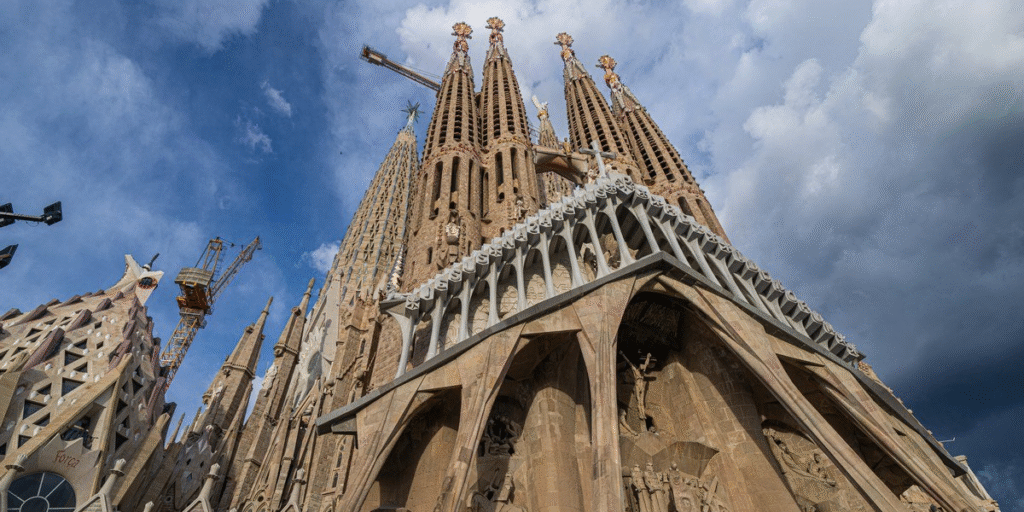
Few buildings in the world inspire as much curiosity, admiration, and wonder as the Sagrada Familia. Rising above the skyline of Barcelona, this extraordinary basilica has become one of the most recognizable architectural landmarks on Earth. Millions of visitors travel from across the globe every year to witness its towering spires, intricate facades, and breathtaking interiors. Yet what makes the Sagrada Familia truly unique is not just its beauty but its remarkable story.
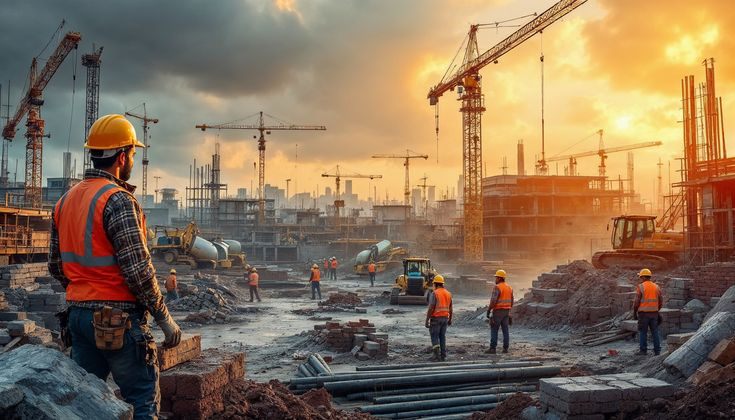
Unlike most famous buildings, the Sagrada Familia has remained under construction for more than a century. Generations of architects, craftsmen, engineers, and artists have dedicated their lives to bringing one visionary dream to reality. Its unfinished state has become as famous as the structure itself, creating an ongoing narrative that continues to captivate people worldwide.
The history of the Sagrada Familia is a story of faith, artistic genius, perseverance, and innovation. Understanding how this magnificent basilica came to be reveals why it remains one of the most fascinating architectural projects in human history.
The Origins of the Sagrada Familia
The story of the Sagrada Familia began in the late nineteenth century when a religious organization known as the Spiritual Association of Devotees of Saint Joseph proposed building a church dedicated to the Holy Family. The project was intended to strengthen religious devotion and provide a significant place of worship in Barcelona.
Construction officially started in 1882 under the direction of architect Francisco de Paula del Villar. His original design followed a traditional Gothic Revival style, which was popular during that era. However, disagreements regarding the project’s direction led Villar to resign after only a year.
At this point, a young architect named Antoni Gaudí was appointed to take over the project. Few people could have imagined how dramatically his involvement would transform the future of the basilica.
Antoni Gaudí’s Revolutionary Vision
When Antoni Gaudí assumed responsibility for the Sagrada Familia in 1883, he completely reimagined the project. Rather than following conventional architectural principles, he sought to create a structure unlike anything the world had ever seen.
Gaudí believed architecture should reflect the beauty and complexity of nature. He studied natural forms extensively, observing trees, plants, mountains, and animals. These influences became central to his designs, leading him to create organic shapes, flowing lines, and structures that appeared almost alive.
Over time, Gaudí devoted nearly all his professional energy to the Sagrada Familia. During the final years of his life, the basilica became his primary focus. He considered it a spiritual mission rather than merely an architectural project.
His vision extended far beyond a traditional church. He imagined a monumental basilica that would communicate biblical stories, Christian teachings, and divine beauty through architecture itself. Every tower, facade, and decorative element was designed to carry symbolic meaning.
The Symbolism Embedded in Every Detail
One reason the Sagrada Familia fascinates visitors is the extraordinary level of symbolism integrated into its design.
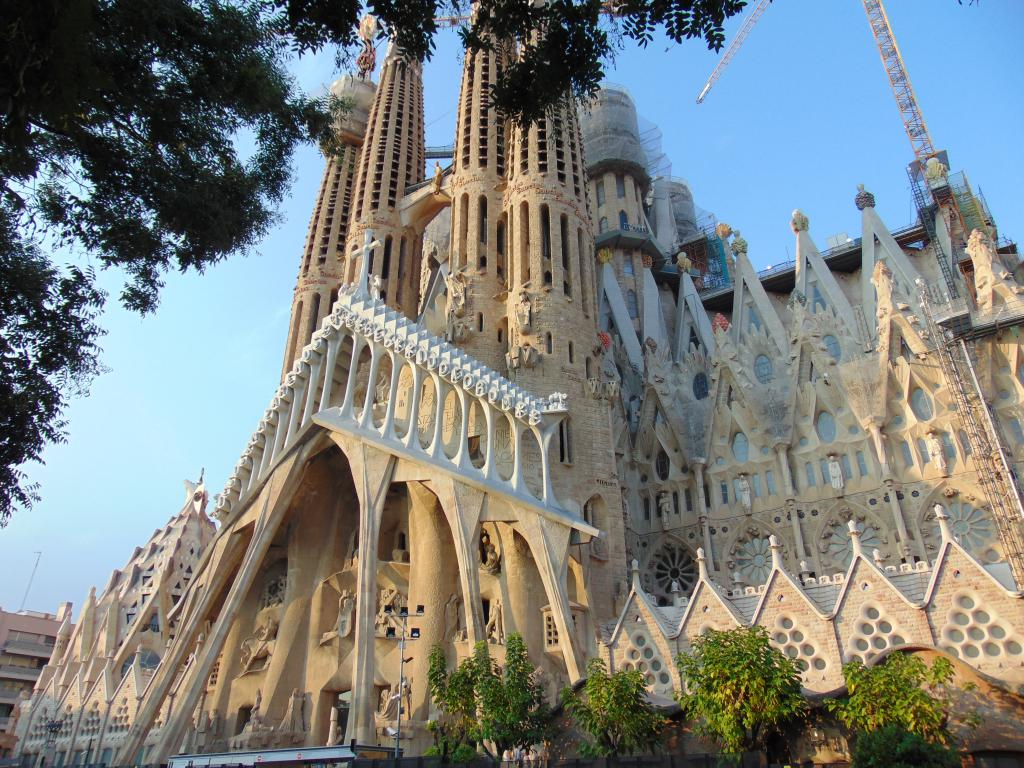
The basilica includes multiple facades, each representing different stages of the life of Jesus Christ. The Nativity Facade celebrates birth and life, displaying intricate carvings filled with natural imagery and scenes from Christ’s early years. The Passion Facade presents a stark contrast, depicting suffering, sacrifice, and crucifixion through dramatic and angular forms.
The Glory Facade, which is still being completed, is intended to represent humanity’s journey toward God and eternal salvation. Together, these facades create a visual narrative that unfolds across the entire structure.
The towers themselves also carry profound symbolism. Once completed, the basilica will feature eighteen towers representing Jesus Christ, the Virgin Mary, the four Evangelists, and the twelve Apostles. Each tower contributes to the building’s spiritual message while enhancing its distinctive silhouette.
Challenges During Early Construction
While the exterior of the Sagrada Familia attracts significant attention, many visitors find the interior even more breathtaking.
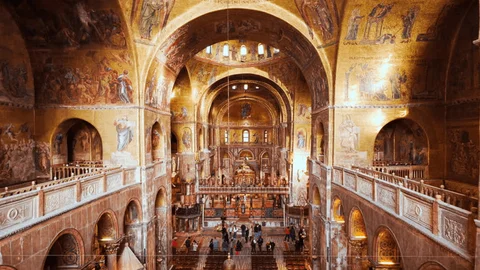
Stepping inside feels like entering a forest made of stone and light. Massive columns branch upward like trees, supporting a ceiling that resembles a natural canopy. Sunlight streams through colorful stained-glass windows, filling the space with shifting patterns of color throughout the day.
Gaudí intended the interior to inspire spiritual reflection through its connection to nature. Rather than relying solely on traditional religious decoration, he used architectural forms themselves to evoke wonder and reverence.
The result is an environment unlike any other church in the world.
The Death of Antoni Gaudí
A major turning point in the history of the Sagrada Familia occurred in 1926 when Antoni Gaudí was struck by a tram in Barcelona. He suffered severe injuries and passed away a few days later.
His death shocked the city and left the future of the basilica uncertain. At the time, only a fraction of the project had been completed. Fortunately, Gaudí had left behind detailed plans, models, sketches, and notes that provided valuable guidance for future architects.
He was buried within the crypt of the Sagrada Familia, symbolically becoming part of the monument he had dedicated his life to creating.
Even after his death, his vision continued to inspire generations of builders determined to honor his legacy.
The Impact of the Spanish Civil War
The progress of the Sagrada Familia faced another major setback during the Spanish Civil War in the 1930s. Political unrest and violence affected much of Spain, and the basilica was not spared.
During the conflict, parts of Gaudí’s workshop were destroyed. Many original drawings, photographs, and plaster models suffered significant damage. For a project already dependent on detailed architectural guidance, this loss represented a serious challenge.
Fortunately, some fragments survived, allowing later architects to reconstruct portions of Gaudí’s plans. Through painstaking research and analysis, experts worked to recover as much of his original vision as possible.
The destruction could have ended the project permanently, yet the determination of those involved ensured construction eventually resumed.
Technological Innovation Accelerates Progress
For many decades, construction continued slowly. However, advances in technology dramatically changed the pace of work during the late twentieth and early twenty-first centuries.
Modern computer modeling allowed architects to interpret Gaudí’s complex geometric designs with unprecedented accuracy. Three-dimensional software made it possible to analyze structural elements that would have been nearly impossible to calculate manually.
Digital fabrication and advanced construction techniques further accelerated progress. Stone components could be designed, tested, and produced with remarkable precision.
Technology did not replace Gaudí’s vision. Instead, it provided tools that enabled modern builders to execute his ideas more effectively than ever before.
As a result, construction began advancing at a much faster rate than in previous decades.
The Stunning Interior of the Basilica
While the exterior of the Sagrada Familia attracts significant attention, many visitors find the interior even more breathtaking.
Stepping inside feels like entering a forest made of stone and light. Massive columns branch upward like trees, supporting a ceiling that resembles a natural canopy. Sunlight streams through colorful stained-glass windows, filling the space with shifting patterns of color throughout the day.
Gaudí intended the interior to inspire spiritual reflection through its connection to nature. Rather than relying solely on traditional religious decoration, he used architectural forms themselves to evoke wonder and reverence.
The result is an environment unlike any other church in the world.
International Recognition and UNESCO Status
As the Sagrada Familia grew in fame, it became one of Spain’s most visited attractions. Its architectural significance earned international recognition from experts, historians, and cultural organizations.
Parts of Gaudí’s work on the basilica were included in the UNESCO World Heritage designation recognizing his contributions to architecture. This acknowledgment reinforced the global importance of the project and highlighted its unique artistic value.
Visitors from every continent continue to travel to Barcelona specifically to experience the Sagrada Familia firsthand.
Its reputation extends far beyond religious significance. It has become a symbol of creativity, innovation, and human perseverance.
Why the Construction Has Taken So Long
One of the most frequently asked questions about the Sagrada Familia concerns its extraordinarily long construction timeline.
Several factors contribute to this extended process. The project’s reliance on donations has historically limited available resources. The immense complexity of Gaudí’s design requires specialized craftsmanship and careful attention to detail. Preservation of artistic integrity often takes precedence over speed.
Additionally, architects have faced the challenge of interpreting and implementing designs created more than a century ago while adapting to modern engineering standards.
The basilica is not simply being built; it is being crafted according to a vision that demands exceptional precision and dedication.
The Future of the Sagrada Familia
Today, construction continues as workers move closer to realizing Gaudí’s dream. Significant progress has been made over the past few decades, bringing the basilica nearer to completion than ever before.
The central towers have dramatically transformed Barcelona’s skyline, and many major structural components are now in place. Although exact completion dates have shifted over time due to various challenges, including global events and construction complexities, the project continues advancing steadily.
Each new milestone represents another step toward completing one of the most ambitious architectural undertakings in history.
A Legacy That Transcends Generations
Perhaps the most remarkable aspect of the Sagrada Familia is its ability to connect generations. Few projects have united so many people across such a long period of time.
Architects, engineers, sculptors, craftsmen, donors, and visitors have all played roles in its story. Many individuals who contributed to the basilica never lived to see the results of their work, yet their efforts remain visible within its walls.
This continuity reflects a powerful idea: some achievements are larger than any single lifetime. The Sagrada Familia demonstrates what humanity can accomplish through patience, vision, and collective dedication.
As construction continues, the basilica stands not only as a masterpiece of architecture but also as a symbol of hope, creativity, and perseverance.
For visitors gazing up at its soaring towers, the Sagrada Familia offers more than a beautiful building. It tells a story that spans generations, reminding us that extraordinary dreams can endure long after their creators are gone
Frequently Asked Questions
1.Where is the Sagrada Familia located?
The Sagrada Familia is located in Barcelona, Spain. It is one of the city’s most famous landmarks and attracts millions of visitors every year.
2.Who designed the Sagrada Familia?
The basilica was designed by the renowned Catalan architect Antoni Gaudí, who dedicated much of his life to the project.
3.Why is the Sagrada Familia still under construction?
The project has taken so long because of its complex design, reliance on private donations, historical interruptions, and the meticulous craftsmanship required to maintain Gaudí’s vision.
4.When did construction begin?
Construction of the Sagrada Familia officially began in 1882, making it one of the longest-running architectural projects in the world.
5.What makes the Sagrada Familia unique?
Its combination of Gothic and Art Nouveau influences, extensive symbolism, nature-inspired design, and ongoing construction make it one of the most unique buildings ever created.